June 2026
NEWSLETTER 35: Ukraine's Deep Strike Diplomacy, Crimea De-occupation, and Russia’s war of attrition
Newsletter was prepared by Daryna Patiuk, Bohdan Kostiuk, Eloi Blonde and Anastasiya Shapochkina; illustration by AI
The United States is signalling a new division of responsibility

A US Navy F14 escorts a tactical Tomahawk Block IV cruise missile
Source : US Navy/AFP/Getty Images
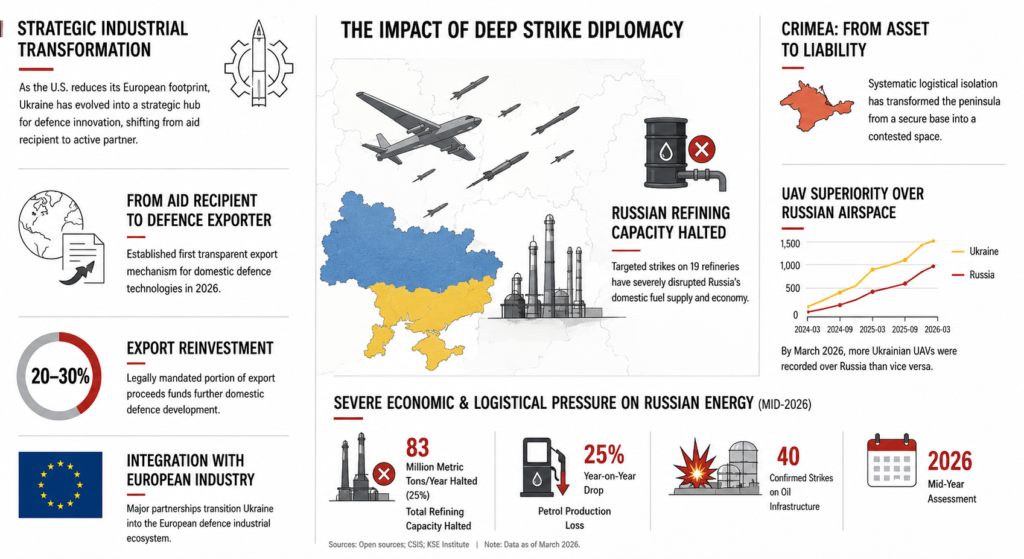
As the United States gradually reduces its role as Europe’s primary security provider, Ukraine is transforming itself from a recipient of military assistance into a producer of strategic military capabilities. Deep strikes are no longer only a battlefield tool—they have become an instrument of diplomacy, reshaping Ukraine’s relationships with both Europe and the United States.
The debate over Germany’s unsuccessful attempt to acquire Tomahawk missiles illustrates a much broader strategic shift. The Trump administration’s 2026 defence posture signals that Washington expects Europe to assume significantly greater responsibility for its own defence. Planned reductions include approximately one-third of fighter aircraft allocated to NATO contingency plans, a massive reduction in strategic bombers assigned to Europe (US F-15 and F-15E fighter jets available to NATO will fall by a third to 99 and the number of MQ-4 and MQ-9 Reaper drones by half to 12), the withdrawal of submarine allocations from NATO planning, and the redeployment of around 5,000 US troops from the continent. While Congress has introduced safeguards preventing troop levels from falling below 76,000 without review, the broader political message is clear: the era of automatic American military reinforcement of Europe is ending.
This shift is driven by several factors. Washington increasingly prioritises competition with China in the Indo-Pacific, expects European allies to fulfil their commitments on defence spending and capability development, and has become frustrated by what it views as European lack of support of the US operations in the Middle East.
Germany’s search for alternatives to American Tomahawk missiles is therefore symbolic. Rather than relying exclusively on its own systems, Berlin is now considering Ukrainian companies such as Fire Point and the BARS missile-drone concept alongside an upgraded Taurus missile. This marks a transformation of Ukraine from a receiver of military assistance, to a strategic partner.
Europe is responding by integrating Ukraine into its defence industrial base
FP-5 Flamingo cruise missile at Eurosatory
Source : Business Insider
The essential element of this strategic partnership is the integration of Ukraine into European defence industrial ecosystem.
Eurosatory 2026 illustrated this transition. More than 2,600 exhibitors from 68 countries and over 350 official delegations gathered in Paris, including 80 Ukrainian defence companies.
The agreements signed during the exhibition reveal a clear pattern of deepening ties through industrial cooperation, which goes beyond « new tech » to include advanced strategic conventional weapons.
In the missile sector, MBDA partnered with Ukraine’s Luch Design Bureau to develop the NEPTUNE2 cruise missile; AviaNera Technologies signed a strategic partnership with Ukrainian Armor to jointly develop missile propulsion systems; and HENSOLDT joined Fire Point’s FREYJA missile defence programme, integrating German radar technology with Ukrainian interceptor missiles.
In robotic systems, Ukrainian companies expanded cooperation with European partners to industrialise unmanned ground systems. Frontline Robotics signed agreements with Denmark’s Dropla and Estonia’s Milrem Robotics, while Ukrainian Unmanned Technologies partnered with France’s Haulotte to scale production of robotic ground vehicles. Ukrainian company AIDronesUA partnered with Sweden’s Njord Technology to launch production of the MAUL robotic casualty evacuation platform in Sweden, with most systems intended for delivery to Ukraine’s Armed Forces. While Greek company Paramount Greece and Ukraine’s MAC HUB broadened their strategic partnership to include counter-drone systems and unmanned maritime platforms, including the newly presented MAC Dead Fly interceptor drone and KATRAN unmanned surface vessel.
At the innovation level, initiatives such as Build with Ukraine and the €20 million BRAVE FRANCE programme demonstrate that cooperation is increasingly centred on joint research, production and battlefield testing rather than one-way military assistance.
These partnerships indicate a structural transformation. Europe is no longer treating Ukraine simply as a country requiring military support. Instead, it increasingly views Ukraine as a source of transfer of approaches and technologies that Europe itself lacks: rapid innovation cycles, combat-tested drone systems, electronic warfare expertise and affordable long-range strike capabilities.
Ukrainian deep strike diplomacy: military operations as new peace deal mechanism
FP-1 drone
Source: Fire Point
Ukraine’s long-range strike campaign during May and June 2026 should be understood not only as a military campaign but also as a diplomatic one, built around two axes..
The first focused on Russia’s energy infrastructure. Repeated attacks targeted oil refineries represent a sustained effort to disrupt Russian logistics and undress the critical supplies capacity in the long-run. Since the beginning of 2026, Ukraine has launched about 3700 deep strikes and middle strikes. During the period May-June, the Ukrainian Armed Forces struck 19 refineries and Russia’reining capacities have dropped by 25%.
The second aims at military infrastructure. Ukrainian forces struck ammunition depots, communications centres, air defence systems, logistics hubs, naval facilities in the Caspian Sea and military-industrial enterprises including the Minudobreniya plant producing basic elements for explosives (ammonia, nitric acid, and ammonium nitrate).
The spring 2026 deep strike campaign has fundamentally altered international perception of the war and of Ukrainian position. Operation Spiderweb, involving 117 drones, deployed across five locations after 18 months of preparation, demonstrated that Russia’s strategic aviation could be attacked thousands of kilometres from the front line. Subsequent daily waves of hundreds of drones, including the record attack of more than 600 drones in late June, showed that these operations were no longer exceptional – they have become a sustained strategic campaign.
President Zelenskyy’s announcement of a coordinated 40-day strike campaign further institutionalised this approach to influence Russian decision-making while simultaneously demonstrating Ukraine’s military capabilities to international partners.
Turning Crimea from an asset to a liability in war
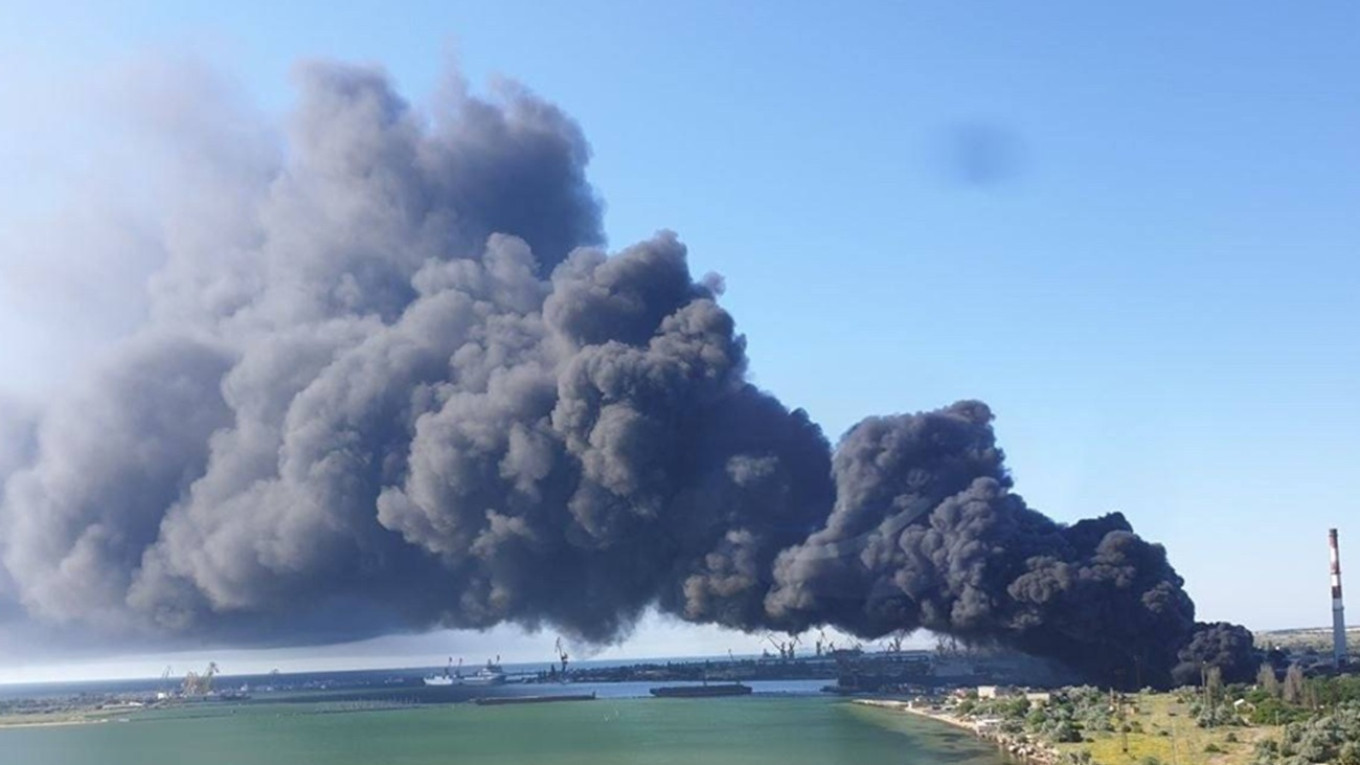
A fire at a thermal power plant in Kerch
Source : The Moscow Times
Perhaps the most significant strategic development has been the transformation of Crimea.
For much of the war, Crimea functioned as Russia’s secure rear base, supporting operations across southern Ukraine. Throughout June 2026, however, Ukrainian forces systematically targeted fuel terminals, railway infrastructure, power facilities, ports, ferries, airfields, air defence systems and logistics corridors connecting Russia to the peninsula.
Rather than seeking immediate territorial liberation, Ukraine appears to be pursuing a strategy of gradual logistical isolation.
According to the Commander Robert Brovdi (« Madyar ») of the Unmanned Systems Forces Ukraine’s short-term objective is to make Crimea hard to keep through disrupting the three pillars of Russian logistics: the Kerch Bridge, the ferry crossings, and the land corridor running through the occupied southern Ukraine.
This represents a fundamental psychological shift. Crimea is turning for Russia from « deep rear » asset to a contested operational space liability, requiring ever more resources to control.
What Ukraine is signalling to the world
Ukraine’s message to Europe has evolved from « Help us defend ourselves » in 2022, to « We can strengthen Europe’s deterrence capabilities » in 2026.
Ukraine is no longer presenting itself solely as a consumer of Western weapons, nor as a maker of cheaper and simpler deftech which can complement conventional systems. Instead, it offers missile technologies, drone systems, robotics, AI-enabled targeting, electronic warfare and combat experience that European defence industries increasingly seek to incorporate into their own future capabilities.
This fundamentally strengthens Ukraine’s negotiating position turning it into a strategic partner of Europe.
Deep strike diplomacy
By the summer of 2026, Ukraine’s long-range strike campaign had achieved effects extending far beyond the battlefield.
It challenged three long-standing assumptions:
- that Moscow was effectively beyond Ukraine’s reach;
- that Crimea was a secure Russian military sanctuary;
- and that Russia’s strategic assets could operate safely far from the front.
At the same time, these operations coincided with growing uncertainty over America’s future military role in Europe and accelerating European efforts to build indigenous defence capabilities.
Together, these developments mark the emergence of deep strike diplomacy—a form of strategic actions in which military capability directly shapes political influence. Ukraine is no longer assessed by the weapons it receives. Increasingly, it is recognised for the technologies it develops, the capabilities it exports and the role it plays in shaping Europe’s emerging security architecture.
Ukraine clarifies the rules of defense exports
On July 1, Ukraine approved its first transparent mechanism for deftech exports, or at least a first shot at creating clear rules of cooperation among the government, manufacturers and international partners. While it clarifies some points, it leaves most open to interpretation.
According to Defense Minister Mykhailo Fedorov, partner countries participating in the Drone Deal initiative and covered by relevant intergovernmental agreements will be able to procure Ukrainian defense products and technologies directly from Ukrainian manufacturers. The new framework introduces a transparent export approval process with applications reviewed within 30 days for transfers valued at over UAH 15 million. The Ministry of Foreign Affairs will determine the list of eligible countries, while the Ministry of Defense and other authorities will define critical items that cannot be exported.
Ukrainian intellectual property will remain protected, with re-export or transfer to third parties requiring Ukraine’s written consent. In addition, 20% of proceeds from exports of finished defense products and technologies, and 30% from exports of components, will be allocated to a special state budget fund to support the development of Ukraine’s defense industry. Exports will only be authorized if they do not compromise the needs of Ukraine’s Defense Forces, ensuring domestic military requirements remain the government’s top priority while supporting the growth and international competitiveness of Ukraine’s defense industry.
Russian war of attrition
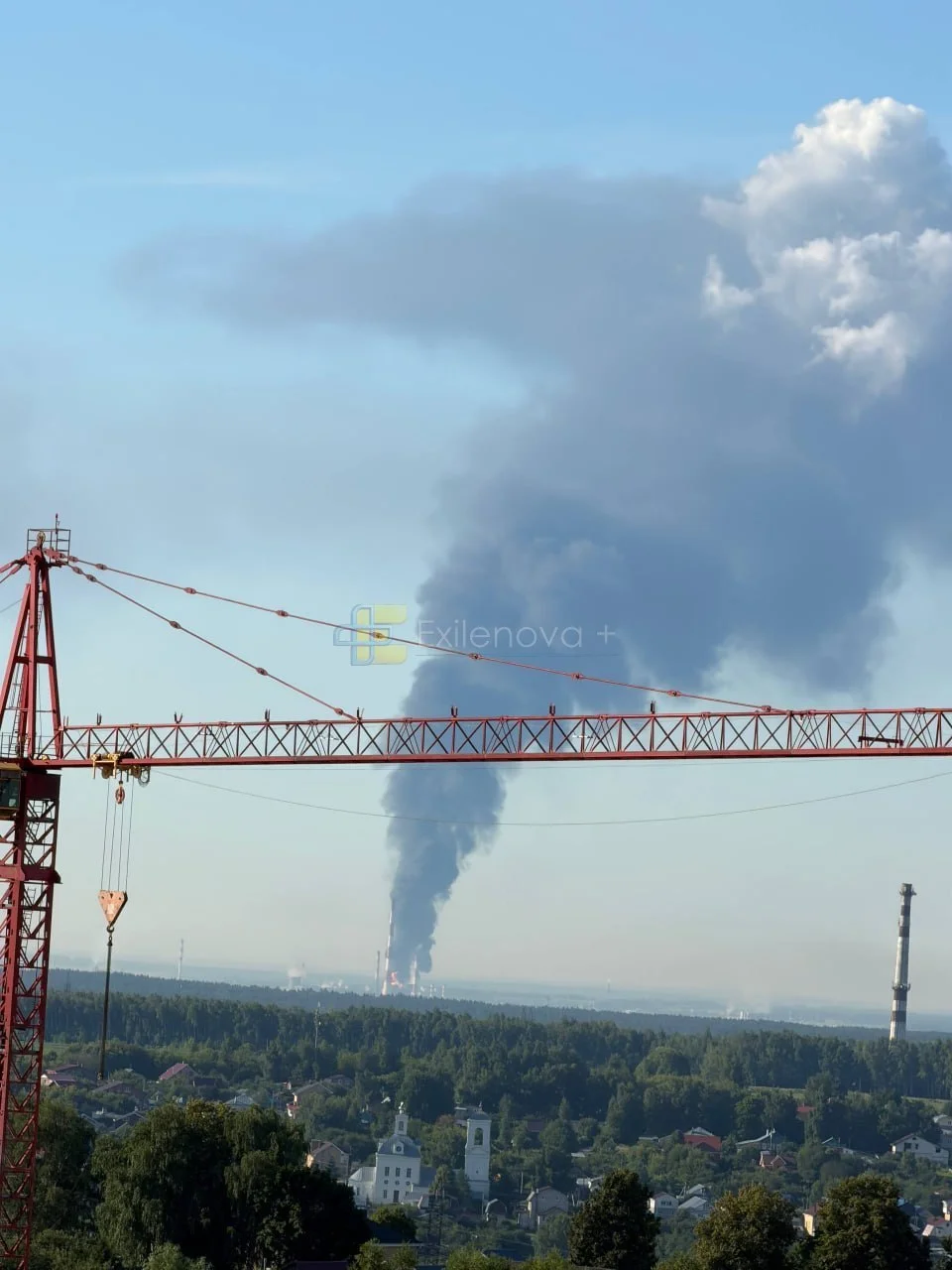
Russian oil refinery in Kstovo
Source : Exilenova+ / Telegram
Ukraine Escalates Long-Range Campaign
During May and June 2026, Ukraine’s deep strike strategy escalated with daily strikes on Russian infrastructure. Since 1 January 2026, more than 3000 drone attacks have been reported over Russian airspace and about 300 missile strikes. In March 2026, for the first time, more UAVs were recorded over Russia than Ukraine. On 18 June 2026, Russia’s Defence Ministry claimed that 992 fixed-wing Ukrainian drones had been intercepted, the biggest drone assault since the beginning of the war. For now, the Russians haven’t found countermeasures to these assaults except relying on their stock of interceptors and moving air defence from the frontline to protect Moscow. The Ukrainian strike on VNIIR Progress plant (research and development institute that specialises in the production of advanced electronic warfare (EW) systems located in Cheboksary, approximately 1500 km from the Ukrainian border) reveals that Russia’s efforts to cage a strategic facility in order to protect it from deep strikes were unsuccessful. But the main target of these attacks remains the oil and gas facilities as Ukraine aims to affect Russia’s war effort by targeting its economy. The recent attacks directly impacted the capital as Moscow’s main oil refinery had been struck twice on June 16 and 18.
Frozen Front, Burning Supply Lines
Russian forces recorded minimal territorial gains in the assessed period, with reported advances of approximately 14 km², marking one of the lowest monthly increases since late 2023. Despite a 37.5% rise in reported assault activity exceeding 7,000 engagements, these efforts did not translate into meaningful operational or strategic breakthroughs. The data indicates continued reliance on small-unit and infiltration tactics, which have become increasingly ineffective against improved defensive detection and response systems.
Ukraine successfully repealed the Russian spring-summer offensive and both sides are holding their ground on the frontline. The Russian troops continue to create a defensive buffer zone next to the international frontier in the Sumy and Kharkiv regions.
Also, Kyiv is conducting a mid-range drone strike campaign focused on disrupting Russian logistics deep behind the front lines, targeting trucks, fuel convoys, and rail-linked supply routes. The system uses modified fixed-wing kamikaze drones such as Hornet and Darts, enhanced with communication upgrades, including Starlink, and ranges reaching up to roughly 250 kilometers. AI is used for target recognition, navigation support, and in some cases terminal guidance, while human operators still typically retain final strike authority. The campaign is designed as a distributed system of units assigned specific road sectors, enabling continuous interdiction rather than isolated missions. Crimea also faces constant strikes from Ukraine to cut off the peninsula from Russia and impose a logistical lockdown on the region. The two main axes of communication, which are the Kerch Bridge and the “Novorossiya” (New Russia” a historical imperial term revived by Vladimir Putin to justify Russia’s claims over southern and eastern Ukraine) highway, are under constant pressure. Russian authorities temporarily closed Kerch Strait bridge on June 22 after several Ukrainian strikes while vehicles carrying critical supplies on the “Novorossiya” highway are still constantly targeted and destroyed by Ukraine.
Regarding Belarus, the country complied with an ultimatum from Ukraine’s president Zelenskyi to remove Russian drone transponders installation based on its soil. Lukashenko turned them off but didn’t dismantle the infrastructures. Although Belarus has provided support to Russia, the country managed not to be involved in the war even if Moscow enticed Minsk to be dragged in under the scope of the Union State Treaty. Recently, Lukashenko went on a tour in Asia looking for support, especially from China to remain out of the conflict.
Cracks in the Refinery: Russia’s Fuel Crisis
Ukrainian deep strikes on oil and gas facilities are directly impacting the Russian economy. In May 2026, Ukraine’s Defence Forces delivered 40 confirmed strikes against Russian oil infrastructure. Russian crude oil production dropped around 5% year-on-year in May to 8.7 million barrels per day, 10% below the monthly target. The situation worsened for Russia’s economy in June after Ukrainian strikes damaged the Moscow refinery, which supplies around 40% of the capital’s petrol. Due to deep strikes, approximately 83 million metric tons per year of Russian refining capacity (about 25% of Russia’s total capacity) is fully halted or significantly reduced. Refineries struck account for more than 30% of Russian petrol production and about 25% of diesel production. Overall, in June 2026, Russia lost about 25% of petrol output compared with the daily average one year ago. The drop reached 90,000 metric tons (765,000 barrels) per day.
On May 21, 2026, Kremlin spokesperson Dmitry Peskov said there was “no risk” of fuel shortages despite Ukrainian strikes on Russian refineries. Later, Vladimir Putin stated during a meeting on domestic fuel supply that Russia’s fuel reserves stood at 1.7 million tons, which he said was 4% lower than the same period last year. However, on the first of April, Russia started to impose the first restrictions regarding petrol export. Several shortages have occurred in many regions of the Russian Federation, leading to queues in gas stations, refuelling limitations and temporary restrictions. Crimean “authorities” declared the state of emergency as the peninsula is under constant blackout, food deficit and fuel is mostly reserved for government and military services.
Faced with a refining sector in crisis, Moscow has had little choice but to look outward for relief.
Imports, Exports, and Export Bans
Russia has to rely on imports to cope with the pressure on its oil industry. The country can rely on Belarus, which increased exports of petrol to Russia by 11% in May compared to April 2026, reaching 57 thousand tons. Shipments of diesel fuel increased by 23%, 50 thousand tons while aviation kerosene reached 5 thousand tons. Overall, from January to May 2026, petrol supplies from Belarus to Russia increased almost 13-fold compared to the same period last year, exceeding 270 thousand tons. Diesel fuel exports tripled to 179 thousand tons. Russia has also planned to begin sea imports of petrol from India and approached Kazakhstan as a potential supplier but no public deal has been released so far.
Despite Ukrainian strikes, Russian crude and oil product exports remained stable at around 7.4 million barrels per day in May reaching US $20.8 billion, 710 million less than in April but 65% higher than a year ago. Russia’s export volume of oil reached its highest level since the beginning of the war in 2022 with 3.46 million barrels exported per day since the beginning of the year. However, this level could decline regarding the situation in the Middle East and the course of peace negotiations between the USA and Iran. Besides, Russia has already applied a total ban on jet fuel exports until November and on petrol exports until July 31. The Russian government is currently discussing the possibility of a total ban on diesel exports in order to stabilise the domestic fuel market.
Inside Russia’s Missile Output
On June 2, Russia carried out its largest ballistic and hypersonic missile attack with about 600 drones and 70 missiles launched. On June 15, Russia launched a similar-scale attack. Russia’s missile production gradually increased to cope with its extensive use on the battlefield. The country is expected to produce 700 ballistic missiles for the Iskander operational-tactical missile system in 2026, which means a production rate of 55-60 missiles/month. Russia also produces 40-50 Kh-101 missiles each month and is expected to produce 60 Kinzhal hypersonic air-launched ballistic missiles during the year 2026. However, as these missiles are sophisticated and expensive, it is difficult to scale their production. That’s why Russia combined their use with converted air defence missiles from the S-300 or S-400 system to saturate Ukrainian air defense. As these systems are easier to duplicate, in 2026, Russia has more than doubled its production pace of RM-48U missiles for S-300PM and S-400 air defence systems. Over 480 of such missiles are planned to be delivered in 2026, compared with around 200 in 2025. The current monthly production rate is up to 50 missiles. Regarding stockpile and production rate, Russia can launch up to 100 such missiles per month on targets in Ukraine.
Russia’s Air Defence Gap
Successful Ukrainian strikes in the deep rear of Russian territory and beyond Moscow’s air defence ring have raised questions about the state of Russia’s air defence system. If the country is able to conduct large drone strikes on Ukrainian soil, it is not prepared to receive massive drone attacks. Large Ukrainian strikes targeting air defence systems combined with Russian offensive use of defence-oriented missiles have led to a reduction of the stockpile of S-300 surface-to-air missiles. Also, if Russia still has in its possession advanced interceptors like the Pantsir or the S-400, these systems are not a long-standing solution to destroy less costly Ukrainian UAVs. Besides, in contrast to Ukraine, Russia hasn’t developed a Sky Fortress acoustic detection network to track and destroy enemy drones. Moscow started to build drone interceptors only in the second-half of 2025 and has fallen behind Ukraine in this field. Also, Russia developed the short-range interceptor Yolka, the system remained limited with an effective range of about 3km (2 miles). Finally, considering the size of the Russian territories and the number of potential targets for Ukrainian systems, it is not possible for Russia to guarantee efficient air defence in all parts of its territory.
To conclude, the Ukraine deep strikes on Russian energy infrastructures are a strategy with long-term effects impacting the Russian economy. With fuel and gas shortages already significant, Russian oil exports are expected to decline over the coming months, directly reducing the Russian state revenues available to support its war effort. Although Russia can reduce the impact of Ukrainian sanctions by importing resources from foreign countries, especially its ally Belarus, this appears barely sufficient to sustain Russia’s large gas and oil demand.
Russia will certainly try to increase its production of interceptor drones to reduce the effectiveness of Ukrainian attacks. However, by the time Russia achieves sufficient production, Ukraine will have had time to scale up and increase its strikes against strategic assets. Ukraine’s ballistic missile program development, expected for 2027, is a key capacity enhancer here. Besides, given the number of UAVs launched each month, any effective protection of energy infrastructure appears impossible. Russia will increase its strikes on Ukraine to improve its negotiating position, but Ukraine’s retaliation capacity strengthens Kyiv’s ability to impose its own terms.
Read other newsletters here
Contact us and follow us to discover more and create great projects


